
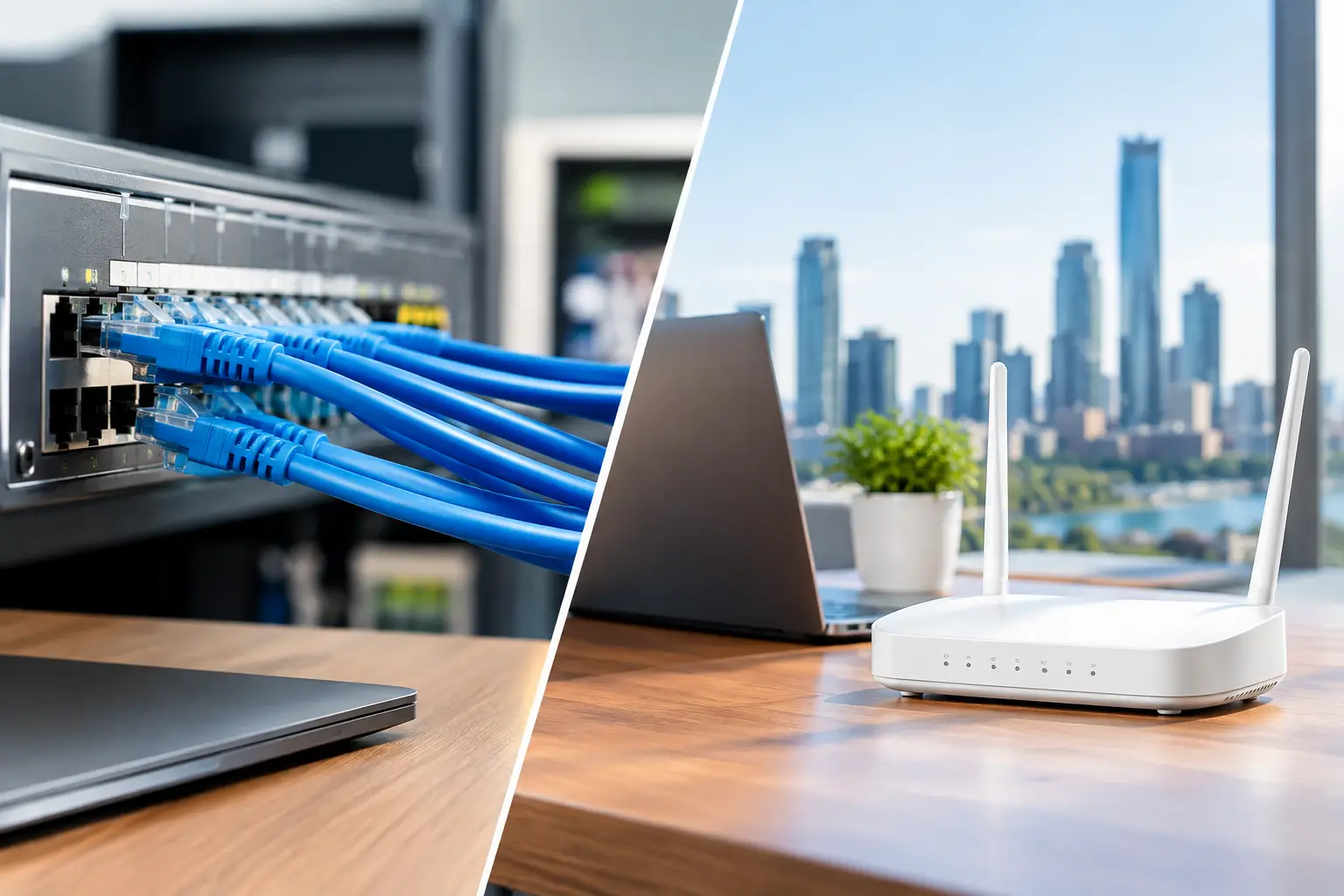
A slow or unreliable internet connection is more than an annoyance when your team relies on cloud software, Teams calls, online bookings, phones and remote access. The leased line vs NBN decision can affect how well your business operates during a busy Monday morning, not just what appears on a speed test.
For businesses across the Central Coast, Newcastle and the Hunter, the right answer is rarely as simple as choosing the fastest plan. It depends on your location, how your staff work, how much downtime costs you and whether your current connection is genuinely holding the business back.
What is NBN for business?
NBN is Australia’s national broadband network. It provides the underlying connection to a large number of business premises, while an internet provider supplies the plan, support and service levels on top of it.
The actual technology available at your address matters. Your premises may have fibre to the premises (FTTP), fibre to the building (FTTB), fibre to the node (FTTN), hybrid fibre coaxial (HFC), fixed wireless or another connection type. These technologies have different speed, upload and reliability characteristics.
A business NBN plan can be a sensible choice for many small and medium-sized organisations. It is usually quicker to provision than a new dedicated fibre service, is widely available and costs considerably less each month. For an office using Microsoft 365, cloud accounting, web-based practice management software and standard video meetings, a well-selected business NBN service may be entirely adequate.
However, NBN services are generally shared services. Your connection is dedicated from your premises to a point in the network, but capacity is shared further upstream. Performance can be influenced by the available technology, network demand and the quality of the provider's network and support.
What is a leased line?
A leased line is a private, dedicated connection between your premises and the provider's network. In Australia, it may also be described as Enterprise Ethernet, business fibre or a dedicated internet access service.
Unlike a typical NBN plan, a leased line normally provides committed bandwidth. If you buy a 100/100 Mbps service, you should receive 100 Mbps for both downloads and uploads, subject to the service agreement. That symmetrical speed is particularly useful for businesses sending large files, running cloud backups, hosting systems or supporting a sizeable number of staff on video calls.
Leased lines also usually come with stronger service level agreements. These agreements set out targets for fault response, restoration time and availability. They do not mean faults can never occur, but they provide a clearer commitment from the provider if one does.
The trade-off is cost and lead time. A leased line is commonly more expensive than NBN, and installation can take weeks or, in some cases, longer. If new fibre construction is needed to reach your building, the upfront cost may be significant.
Leased line vs NBN: the practical differences
The biggest difference is predictability. NBN can deliver very good performance, particularly where FTTP is available and the provider has sufficient capacity. But it is generally designed as a shared access service. A leased line is purchased for organisations that need a known level of performance and support.
Upload speed is another important distinction. Many NBN plans provide much faster downloads than uploads. That suits web browsing and ordinary email, but can become restrictive when staff regularly upload design files, medical imaging, site photos, large reports or backup data. A leased line commonly offers equal upload and download speeds.
Cost follows the level of assurance. A business NBN connection may be a few hundred dollars per month depending on the plan, while a leased line can be substantially more. Comparing the monthly price alone can be misleading, though. If a two-hour outage stops 20 staff from working, prevents a medical practice from accessing patient systems or takes phones offline in a busy sales team, the cheaper service may not be the lower-cost option overall.
Support also differs between providers and products. A business-grade NBN plan with responsive local support can be a major improvement over a consumer service. A leased line generally offers more formal fault-management commitments, but it is still worth asking who owns the issue, how faults are escalated and what happens outside business hours.
When NBN is usually the sensible choice
NBN is often the right fit for a small office with modest cloud use, particularly if FTTP is available. A five-person accounting firm, real estate office or trade business may have no practical need for dedicated fibre if its systems run well, video meetings are stable and a short outage would be inconvenient rather than business-critical.
It can also be a sensible primary connection when paired with a backup service. For example, an office might use business NBN for day-to-day work and keep a 4G, 5G or second fixed connection ready to take over if the main service fails. This approach can provide strong resilience without the ongoing price of a leased line.
Before assuming NBN is the problem, check the basics. An ageing router, poorly configured Wi-Fi, inadequate office cabling or a connection shared with guest devices can all create symptoms that look like an internet fault. Improving the internal network may deliver a better result than changing carriers.
When a leased line earns its cost
A leased line is worth serious consideration where connectivity is central to revenue, service delivery or safety. This may include a multi-site professional services firm, a manufacturing business sending production data, a warehouse relying on cloud-based logistics systems, or a medical practice with high dependence on online clinical platforms.
It is also suitable for businesses with 20 to 100 staff working heavily in the cloud. A growing team can quickly outpace an internet service that was suitable when there were only six people in the office. Constant video meetings, cloud file synchronisation, hosted phone systems and remote staff can all compete for the same bandwidth.
A dedicated service is particularly valuable if lost connection means lost transactions. For example, a Newcastle-based business with an online support desk and cloud phone system may need guaranteed bandwidth and defined restoration targets because an interruption affects every customer conversation.
That said, a leased line is not automatically the best choice for every larger business. If your key systems have offline options, staff can work from mobile connections during an outage and current performance is consistently good, a high-quality NBN service with a properly designed backup connection may be more practical.
Do not confuse NBN Enterprise Ethernet with standard NBN
This is where terminology can become confusing. NBN also has Enterprise Ethernet services available at some addresses. These are business-grade fibre services delivered over the nbn network and can offer symmetrical speeds and stronger service commitments than standard NBN plans.
In practical terms, an Enterprise Ethernet service can have many of the benefits people associate with a leased line. The exact design, service level agreement, construction costs and availability still need to be assessed for your premises. Rather than relying on the label, ask whether bandwidth is committed, whether speeds are symmetrical, what restoration target applies and whether the connection is physically diverse from any backup service.
Questions to ask before choosing
Start with the impact of an outage. Consider how long staff could work without internet, which systems would stop and what the interruption would cost in missed work or customer service.
Then look at real usage rather than advertised plan speeds. Review how many people are online at once, how often staff use video calls, whether you upload large files and whether phones, cameras or guest Wi-Fi share the same connection. It is also worth checking the technology available at your exact address, as a nearby business may have a very different service option.
Finally, plan for failure. Even the best primary service can be cut by building works, equipment faults or wider network issues. For businesses that cannot stop, a secondary connection, automatic failover and tested procedures matter just as much as the primary service.
The best internet decision is the one that matches your business risk, not the one with the most impressive headline speed. A clear assessment of your site, workloads and downtime tolerance will show whether business NBN, dedicated fibre or a combination of both is the sensible next step.